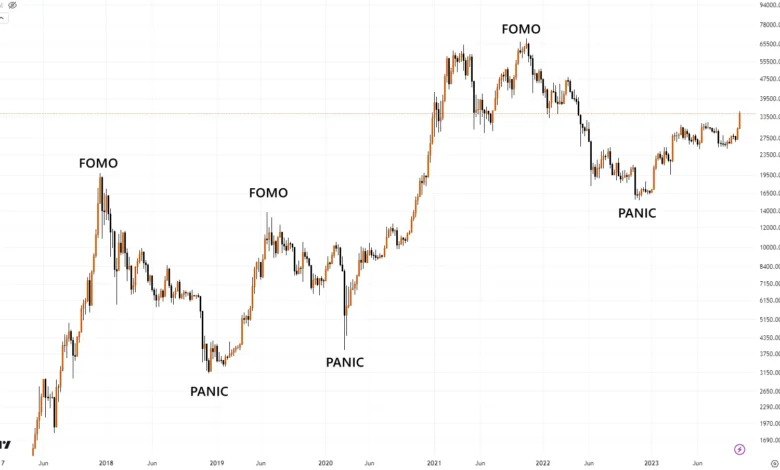
Trading Isn’t Just Technical — It’s Deeply Emotional
Most people enter the world of crypto trading expecting to master charts, indicators, and news cycles. But what they often overlook is that one of the biggest challenges in trading isn’t external — it’s internal. Emotions like fear, greed, FOMO (fear of missing out), and FUD (fear, uncertainty, and doubt) drive a large percentage of market moves, especially in a space as volatile as cryptocurrency.
Understanding the psychology of trading is crucial not only for protecting your capital but also for maintaining mental clarity and discipline in the face of wild price swings.
Greed: The Trap of “Just a Little More”
Greed kicks in when a trader sees their portfolio growing fast — and wants to squeeze just a bit more profit. This can lead to overleveraging, ignoring exit strategies, or jumping into late-stage rallies right before a correction.
Crypto markets are especially prone to greed-induced bubbles. It’s easy to believe an asset will “never go down again” — until it does. Having a clear profit-taking plan can help avoid turning gains into losses.
Fear: The Great Exit Trigger
On the flip side, fear causes people to sell too early, panic-sell in red markets, or completely exit space after a bad trade. Fear is often driven by headlines, Twitter rumors, or sharp price drops.
Instead of reacting emotionally, traders should have predefined stop-losses, risk management strategies, and time-tested convictions about their positions. When fear dominates logic, portfolios suffer.
FOMO: Fear of Missing Out on the Next Big Thing
FOMO is arguably one of the most destructive psychological triggers in crypto trading. A token starts surging, influencers are tweeting, and suddenly it feels like “everyone is getting rich except me.” That’s when people rush in — often at the top — without doing research or checking the fundamentals.
To avoid FOMO, smart traders set entry strategies based on technical or fundamental indicators, not social hype. They also understand that missing a trade is better than losing on a bad one.
FUD: Fear, Uncertainty, and Doubt
FUD spreads like wildfire in crypto — whether it’s rumors of hack, government regulation, or a major exchange collapse. These events can trigger massive selloffs, even when the facts are unclear or exaggerated.
Seasoned traders learn to separate noise from signals. They research from multiple sources, follow credible analysts, and avoid knee-jerk reactions to every tweet or headline.
The Role of Confirmation Bias and Overconfidence
Many traders fall into the trap of confirmation bias — only seeking out information that agrees with their existing views. If you’re convinced Bitcoin will hit $100K soon, it’s easy to ignore any bearish arguments.
Others become overconfident after a string of wins, taking bigger risks or abandoning discipline, believing they’ve “cracked the code.” But in crypto, humility and adaptability are often more valuable than arrogance and rigid thinking.
Developing Emotional Discipline
So, how do you train your psychology for crypto trading?
- Set clear goals and rules before entering any trade.
- Use stop-losses and take-profit levels — and stick to them.
- Keep a trading journal to track what worked, what didn’t, and why.
- Take breaks from the screen, especially after emotional tragedy.
- Avoid revenge trading — doubling down after a loss rarely ends well.
Being aware of your emotional state is half the battle. The other half is taking steps to control your reactions instead of being controlled by them.
Automation and Bots: Trading Without Emotion?
Some traders use bots or algorithmic systems to avoid emotional pitfalls. These systems operate purely on data, removing the human element — but they aren’t foolproof. Bots still require strong strategies, and poor settings can lead to just as much loss.
That said, using bots to enforce discipline — like automatic stop-losses or structured position sizing — can be a powerful way to keep emotions in check.
SEO Optimization and Trading Psychology Education
There’s growing demand for content that explains the mental side of trading, especially in crypto. Websites and platforms using SEO optimization to target phrases like “how to control emotions in crypto,” “psychology of trading,” or “avoid FOMO in crypto” are helping thousands of traders gain clarity.
Educational blogs, videos, and courses that cover emotional intelligence are becoming as valuable as those covering technical analysis — and they’re easier to discover when paired with smart SEO strategies.
Master Your Mind, Master the Market
You can learn every chart pattern, study every indicator, and follow every influencer — but if you can’t manage your emotions, success in crypto trading will remain elusive. The market will test your patience, your confidence, and your emotional resilience at every turn.
The best traders are not just analysts — they’re also psychologists. They’ve trained themselves to stay calm under pressure, act on logic rather than emotion, and focus on long-term growth instead of short-term highs.
And with the help of SEO optimization, more traders than ever can access this knowledge, build emotional discipline, and take control of their crypto journey — one mindful decision at a time.