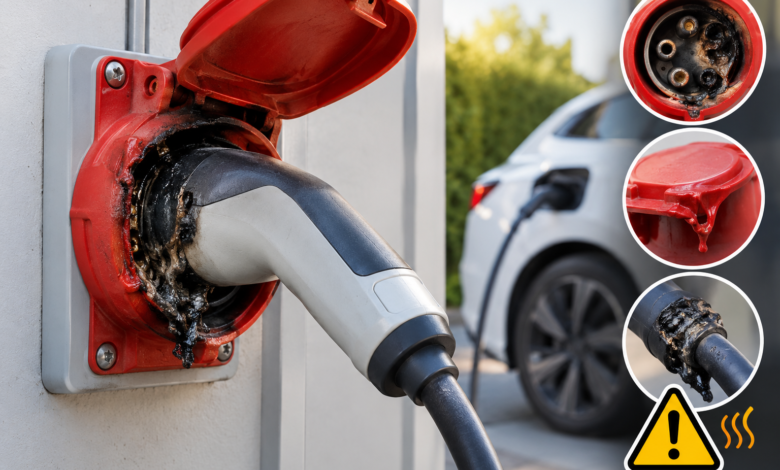
Why CEE plugs and sockets can overheat or melt during EV charging, what heat damage looks like, and how to reduce the risk.
A CEE connector is designed for demanding electrical loads, but poor contact, incorrect wiring, or a mismatched continuous load can still create abnormal heat.
Melting is never a normal side effect of EV charging.
If you see charring, discoloration, softened plastic, smell burning, hear sparking, or notice repeated breaker or RCD trips, stop using the connection until the cause has been identified.
Quick Answer
Yes. Abnormal heat can damage or melt a CEE socket. Common causes include worn contacts, poor connections, incorrect wiring or current, and prolonged load. Visible damage, burning smells, sparking, or melting mean charging should stop.
Can a CEE Socket Actually Melt?
Yes. Severe overheating can soften, deform, scorch, or melt plastic around a CEE plug or socket.
EV charging is a sustained electrical load. If resistance rises at a weak contact point, heat becomes concentrated there and can build during a long charging session.
The problem is usually abnormal resistance or an unsuitable electrical connection under sustained load—not normal EV charging itself.
What Causes a CEE Socket to Melt?
Contact Resistance
If a contact becomes loose, oxidized, worn, or damaged, resistance can increase.
Loose or worn contact → higher contact resistance → localized heat → discoloration or plastic softening → possible melting or charring
Aged or Worn Sockets
Older CEE outlets can lose contact pressure. A loose-fitting plug should be inspected.
Loose Terminals or Poor Wiring
A hidden loose terminal, damaged conductor, or unsuitable cable size can create heat under continuous load.
Why Can Heat Appear Only After 30 Minutes or Several Hours?
A weak connection may not become hot immediately. Because EV charging can continue for hours, a small resistance problem may gradually create more heat.
Current Mismatch
The socket, voltage, phases, wiring, protective devices, EVSE, and vehicle must all be compatible with the intended charging current.
Does a 16A or 32A Rating Mean You Can Always Charge at That Current?
No.
A 16A or 32A rating does not mean every installation can safely deliver that current continuously.
| Typical CEE Setup | Phase | Potential EV Charging Power* |
| CEE 16A / 400V | Three-phase | Up to ~11kW |
| CEE 32A / 230V | Single-phase | Up to ~7.36kW |
Actual power depends on the vehicle, charger, and electrical installation.
Before charging, confirm the socket type, voltage, phases, circuit protection, EVSE limits, and the vehicle’s AC charging capability.
Should You Lower the Charging Current?
Lowering current can reduce electrical load in a suitable installation.
For example, the EVDANCE 11kW CEE Mobile Wallbox is designed for compatible 400V three-phase CEE 16A setups and supports adjustable charging current within its specified range.
But:
A lower charging current is not a repair for a damaged socket or poor electrical connection.
Reducing current may reduce the symptom, but it will not fix loose contacts, damaged terminals, corrosion, or a scorched socket.
What Warning Signs Mean You Should Stop Charging Immediately?
Stop charging if you notice:
- Strong or increasing heat
- Brown or black discoloration
- Burning or hot-plastic smell
- Softened or melted plastic
- Sparking, buzzing, or crackling
- Repeated breaker or RCD trips
- A loose plug
Do not repeatedly reconnect the EV to “test” a damaged connection.
What Should You Do If You See Melting or Discoloration?
Stop charging. Disconnect the equipment only if it is safe to do so.
A competent electrician should inspect the socket, terminals, wiring, circuit protection, and surrounding installation before reuse.
Heat-damaged charging equipment may also need inspection or replacement.
How Can You Prevent CEE Plug and Socket Overheating?
1. Verify the Installation
Make sure the socket, wiring, protective devices, and circuit are suitable for the intended continuous load.
2. Match the Correct CEE Configuration
Choose the charger around the actual socket, voltage, phase configuration, and current rating.
3. Select the Correct Current
Do not use a charging current above what the installation can safely support.
4. Inspect the Socket and Contacts
Look for loose fit, corrosion, discoloration, cracked parts, or damaged insulation.
5. Keep Connections Clean and Dry
Contamination, moisture, and corrosion can interfere with a reliable connection.
How EVDANCE Supports Safer CEE Charging
EVDANCE offers CEE charging solutions for different European power configurations rather than treating all CEE outlets as the same.
Match the Charger to the CEE Supply
CEE 16A / 400V three-phase and CEE 32A / 230V single-phase setups have different electrical characteristics.
EVDANCE provides different CEE configurations so drivers can choose around the available socket, voltage, phase, current, and vehicle requirements.
Monitor the Charging Session
Supported EVDANCE models can provide information such as current, voltage, charging power, charging time, and status. APP monitoring is available on selected models.
Monitoring can reveal unusual behavior, but it does not replace inspection.
Protection Adds a Layer — It Does Not Repair the Socket
Depending on the model, EVDANCE CEE chargers can include temperature monitoring, overheat protection, leakage protection, and other electrical protections.
These features add a layer of protection. They cannot make a damaged CEE socket safe.
Before choosing a charger, confirm:
- CEE 3-pin or 5-pin
- 230V or 400V
- Single-phase or three-phase
- 16A or 32A
- Vehicle connector and AC charging limit
- Basic or smart monitoring needs
Drivers comparing these configurations can view EVDANCE CEE EV Chargers to find a setup that matches the available power supply.
Before Charging Again: 7 Things to Check
✓ No burn or melt marks on the socket
✓ Plug fits firmly
✓ Current setting matches the installation
✓ Wiring and circuit are correctly sized
✓ No unusual smell, sparking, or noise
✓ Breaker or RCD is not repeatedly tripping
✓ Previous overheating has been professionally investigated
A melted CEE socket is not a normal consequence of EV charging. Find and correct the cause before charging again.