Why Is RAM So Expensive Now? The Ultimate Guide to 6 Reasons, Pro Tips & What Matters Most

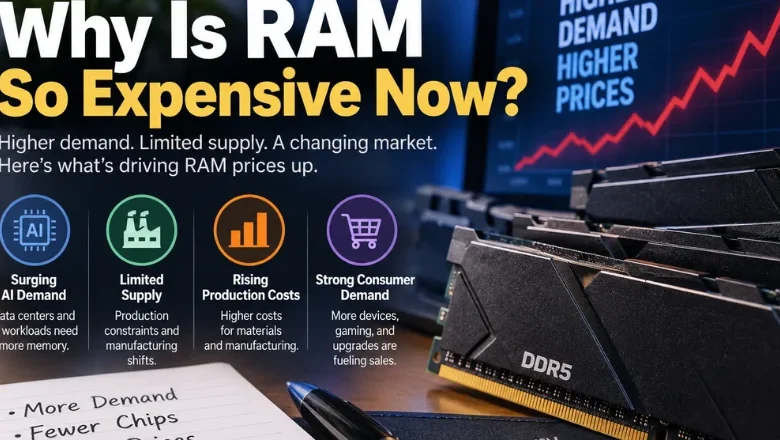
If you are wondering why is RAM so expensive now, the answer is mostly supply pressure. AI infrastructure is pulling memory capacity toward servers, while PC-grade supply stays tight. U.S. shoppers are seeing the result in unusually high DDR4 and DDR5 prices.
Direct answer: RAM is expensive in 2026 because memory manufacturers are selling into a tight global market. AI servers consume huge amounts of DRAM and HBM, while consumer supply has not expanded fast enough. DDR4 production cuts add another squeeze, and new fabrication capacity takes years to arrive.
| Key Factor | What Is Happening in 2026? | Effect on U.S. Buyers |
|---|---|---|
| Why Is RAM So Expensive Now | AI demand, constrained DRAM supply, and shifting production priorities are pushing memory prices higher. | U.S. buyers may face higher RAM prices and fluctuating availability. |
| AI server demand | Data centers need large amounts of DRAM and HBM. | Less supply flexibility for consumer memory. |
| Tight conventional DRAM supply | Production growth trails demand. | Higher contract and retail prices. |
| DDR4 supply reductions | Older production is being reduced. | DDR4 can cost more despite its age. |
| Server prioritization | Suppliers favor higher-value enterprise products. | Desktop and laptop buyers face tighter availability. |
| Slow factory expansion | New fabrication plants take years. | Supply cannot increase quickly. |
| Retail inventory swings | Stores receive stock at different costs. | Prices can change sharply between sellers. |
Key takeaways
- AI servers are increasing demand for both high-bandwidth and conventional memory.
- TrendForce forecasts conventional DRAM contract prices to rise another 13–18% in the third quarter of 2026.
- DDR4 remains expensive because production is shrinking while many systems still need it.
- DDR5 is also pressured because server demand competes for manufacturing resources.
- Short-lived discounts can appear, but they do not prove the broader shortage has ended.
- Buyers should compare real upgrade needs before paying today’s unusually high prices.
Why Is RAM So Expensive Now in 2026?
The biggest issue is that demand has risen faster than manufacturers can increase useful supply. Modern AI servers require far more memory than ordinary consumer computers. Suppliers can also earn more from advanced server products than from many desktop modules. TrendForce described the third-quarter DRAM market as extremely tight in July 2026.
It forecast conventional contract prices rising another 13–18% from the previous quarter. Consumer demand weakened, but limited supply kept sellers in a strong pricing position. This is different from a temporary shortage caused by one delayed shipment. The industry is changing what it manufactures and which customers receive available capacity. That shift makes the current pricing problem harder to solve quickly.
1. AI Servers Are Absorbing Huge Amounts of Memory
AI data centers are the largest new source of pressure on the memory market. Training and running advanced models requires large pools of fast memory. Servers also use high-capacity DDR5 modules alongside specialized HBM. TrendForce reported that AI demand helped drive DRAM industry revenue up 59.5% quarter over quarter in the second quarter of 2026.
Supplier inventories remained at historically low levels during that period. Available additional supply was being directed mainly toward servers. High-bandwidth memory does not directly replace ordinary desktop DDR5. Both products still depend on overlapping manufacturing resources and investment decisions. More production devoted to high-value server products can leave less flexibility elsewhere.
SK hynix has described 2026 as an HBM-led memory supercycle. The company expects continued growth from AI infrastructure and high-capacity server memory. That demand encourages manufacturers to prioritize products serving data centers.
2. Conventional DRAM Supply Is Not Growing Fast Enough
Desktop memory prices depend on the supply of conventional DRAM chips. That supply cannot expand immediately when prices begin climbing. Semiconductor factories require expensive equipment, complex process changes, and long construction schedules. SK hynix announced major new fabrication investments in August 2026. Its M17 cleanroom is targeted for December 2028, while Yongin Y2 targets June 2029.
Those dates show why today’s shortage cannot be fixed by opening capacity next month. Manufacturers can improve output through newer production nodes before new plants arrive. Yet those improvements still compete with growing server requirements. TrendForce expects server supply conditions to remain tight as demand expands.
That imbalance gives chip manufacturers stronger pricing power. PC makers and module companies then pay higher costs for their components. Retail customers eventually see those increases in finished memory kits. For more coverage of computer components, see TechZena’s hardware guides. The section covers other hardware issues that can affect upgrade decisions. It is useful when planning a wider system refresh.
3. DDR4 Production Cuts Are Creating a Second Squeeze
Older technology normally becomes cheaper as newer hardware takes over. DDR4 is behaving differently because manufacturers have reduced production while demand remains substantial. Millions of existing desktops, laptops, servers, and specialized systems still require it. TrendForce said in May that DDR4 shortages were expected to continue through 2026.
It added that Micron’s Virginia production expansion would not increase the company’s total global DDR4 and LPDDR4 capacity. TrendForce expected the technology to remain in short supply. Major manufacturers had already announced end-of-life plans for parts of their older product portfolios. That creates an unusual situation for buyers maintaining older PCs. Supply falls before demand disappears completely.
This explains why switching from DDR5 to an older platform doesn’t guarantee cheaper memory. A mature technology can become more expensive when factories stop making enough of it. Age alone does not determine semiconductor pricing. Before replacing other components, TechZena’s motherboard guides can help you review platform compatibility. DDR4 and DDR5 motherboards generally require different memory generations. Buying the wrong kit can turn an expensive upgrade into a useless purchase.
4. Micron’s Crucial Exit Reduced a Familiar Consumer Option
Another change affected shoppers directly in early 2026. Micron ended its Crucial consumer memory business after announcing the decision in December 2025. Consumer-channel shipments continued only through Micron’s fiscal second quarter. Micron specifically connected that decision with AI-driven data center demand. The company said it wanted to support larger strategic customers in faster-growing segments.
That does not remove Micron chips from every consumer product, but it changed retail competition. Crucial had been a familiar option for U.S. PC builders for years. Its exit reduced the number of major manufacturer-owned brands competing directly for consumer purchases. Other module companies still sell products using chips from major DRAM suppliers.
The change also illustrates where manufacturers see the strongest business opportunity. Enterprise customers can sign large contracts and secure substantial volumes. Individual PC buyers have far less purchasing power.
5. U.S. Retail Prices Reflect the Supply Shock
The increase is visible in U.S. retail tracking, not only in industry contracts. Tom’s Hardware recorded sharp price increases across mainstream DDR5 capacities in August 2026. Some kits were several times their previous tracked lows. Its August 17 tracking listed 32GB DDR5-6000 around $392 in the United States. The publication listed a previous low near $72 for the same capacity and speed category. A 64GB DDR5-6000 entry was listed around $849.
These examples should not be treated as fixed market prices. Memory pricing changes quickly between brands, speeds, timings, and retailers. Sales can also appear when distributors have older inventory purchased at lower costs. Framework recently demonstrated how uneven the market can be. It lowered some laptop memory pricing after securing limited Micron LPCAMM2 stock at a better cost. That was a specific supply opportunity, not proof of broad normalization.
6. New Supply Takes Years to Reach Store Shelves

Memory manufacturers are spending heavily to increase production capacity. That investment matters, but semiconductor factories cannot be completed quickly. Construction is followed by equipment installation, qualification, yield improvement, and customer validation. The growing technical complexity of advanced memory creates another constraint.
SK hynix notes that HBM requires more wafer capacity to produce the same amount of memory. Advanced stacking and packaging also increase manufacturing demands. That means rising investment does not automatically produce immediate consumer relief. Much of the new capacity is also designed around future AI requirements. PC buyers remain part of a much larger competition for memory production.
Reuters reported on September 16 that smaller device manufacturers expect prolonged scarcity. Industry executives cited supply concerns extending through 2027 and potentially beyond. Current evidence therefore gives little support for expecting an immediate return to old pricing.
Should You Buy Memory Now or Wait?
Buying now makes sense when insufficient capacity is limiting your computer today. A work machine running out of memory can cost more in lost time than the upgrade. The same applies when you can’t postpone a required build. Waiting can make sense when your current system already performs well. Paying several times an older historical price for unused capacity provides little practical benefit. Prices can still fluctuate downward temporarily even during a tight market. You might also like Samsung Galaxy S25.
For a gaming computer, prioritize the capacity your workloads need instead of chasing the largest kit. Many mainstream users can work comfortably without extreme capacities. Check your applications, motherboard limits, and current utilization before ordering. You can also review TechZena’s guides for PC builders while planning component purchases.
Comparing the whole build can reveal better places to spend a limited budget. An expensive memory upgrade should not starve more important components.
What Could Make Memory Prices Fall?
A meaningful decline would require supply growth, weaker demand, or both. Manufacturers could increase output faster than expected, while AI infrastructure spending could also cool. Either change would reduce pressure on available production. Consumer demand is already weakening as buyers resist higher prices.
TrendForce says that pressure has slowed the pace of contract-price increases. It has not yet removed the underlying supply shortage. New fabrication capacity will eventually give manufacturers more room. Yet several large announced facilities will not contribute immediately. Buyers should treat dramatic short-term price forecasts with caution.
Frequently Asked Questions
Why is RAM so expensive now?
AI infrastructure has increased demand across the memory industry while manufacturing supply remains tight. Suppliers are prioritizing profitable server products, and conventional DRAM capacity has not expanded fast enough. Older DDR4 products face additional pressure from production reductions.
Is AI really responsible for higher memory prices?
AI is a major factor, but not the only one. Data centers need HBM, server DDR5, and other memory products in enormous quantities. Production decisions, low inventories, DDR4 reductions, and slow factory expansion add further pressure.
Why is DDR4 expensive if DDR5 is newer?
DDR4 supply is shrinking before demand has disappeared. Existing computers, networking equipment, industrial devices, and other systems still use the older standard. Reduced production can push prices upward even for mature technology.
Will memory prices fall in 2027?
No reliable source can guarantee a specific date for broad price relief. Current industry reporting still points to tight supply extending into 2027. New capacity and weaker demand could change conditions, so buyers should watch actual prices.
Is it cheaper to buy a prebuilt PC instead?
Sometimes a prebuilt manufacturer has memory inventory secured under earlier contracts. That can make a complete system comparatively attractive during a component shortage. Compare the full specification, because cheaper memory can be offset by weaker components elsewhere.
Should I upgrade from 16GB to 32GB in 2026?
Upgrade when your real workloads regularly approach your current capacity. Heavy multitasking, creative applications, development tools, and some games can benefit from 32GB. Casual users should check utilization before paying today’s premium.